AI Agent & Coding ·
Now it's Claw.
English translation of the Chinese original. This version is generated for international readers and may be refined over time.
English translation of the Chinese original. This version is generated for international readers and may be refined over time.
Date: 2026-03-11
One, start with the lobster
The founder of OpenClaw, Peter Steinberger, spoke of Peter Steinberger, who really did nothing.
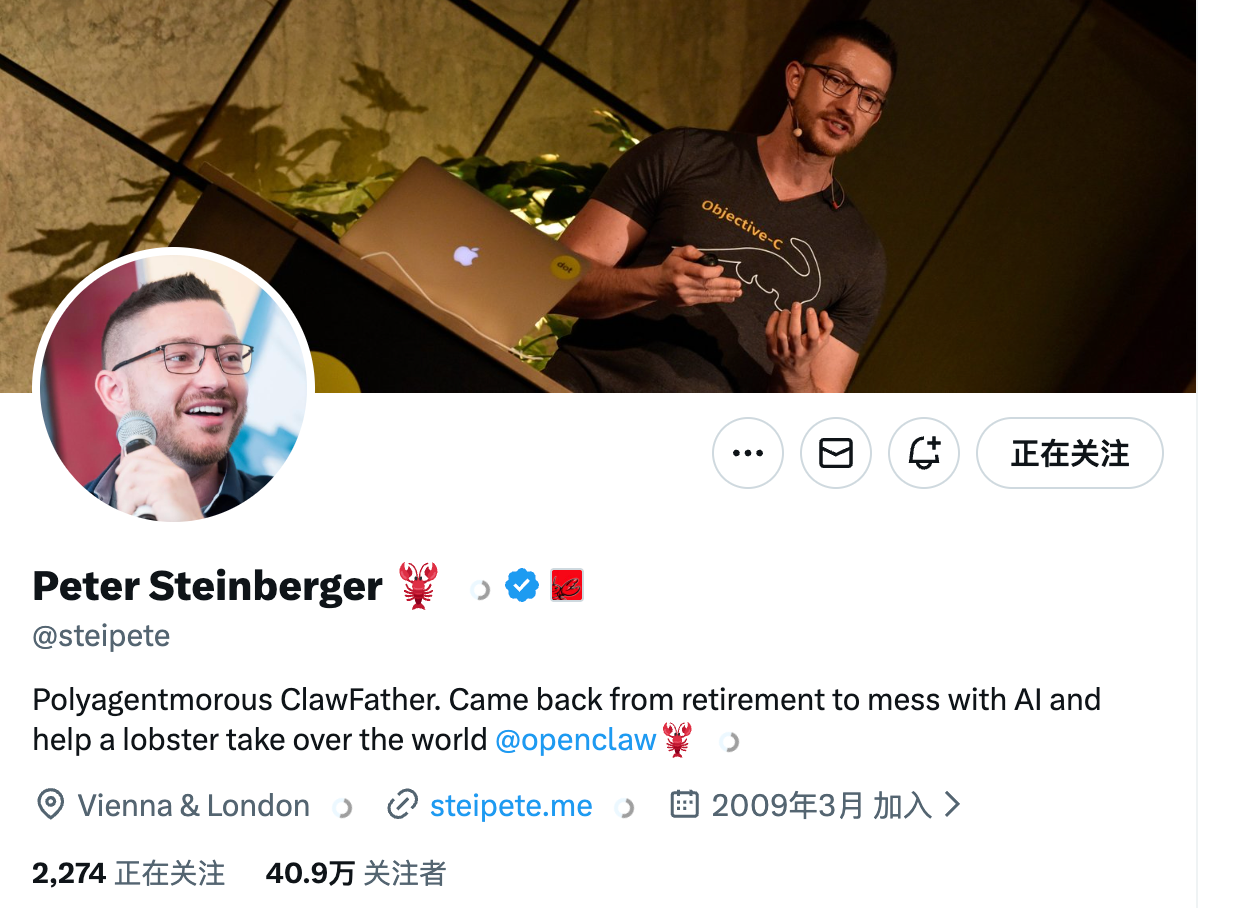
At the age of 14, it was the first time that a computer had been touched, that a game protection program was sold in junior high school, that a web-based development was started in high school, and that, in 2011, the SPPDFKit was created to cover a billion pieces of equipment, get a billion euros in investment, and then get tired, lie down, and go out.
Enough playing back, 2025. In November, in a hotel room in Marrakech, Morocco, it took an hour to write a prototype -- to glue whatsApp, Claude Code and some tools. Together, made an AI assistant who can really help you with things.
It was called Clawdbot. Subsequently, Claude, under the banner of Anthropic, was offended by the harmony of his name, and a legal letter was sent to change his name. Changed to Moltbot, resulting in a 10-second gap in the name changer, an encrypted currency swindler took the old account and issued a false token. OpenClaw, this time ready: trademark search, domain booking, migration code, secrecy like Manhattan.
Three names changed in a week. The r/LocalLLM community on Reddit describes this as "the fastest three companies in open source history to change name".
The change of name would have been a bad thing, as a result of which the country 's cloud manufacturer reacted quickly and packed Clawdbot into a cloud server application template while taking advantage of the heat. Users can deploy once they have bought the server. The wave moved an open source project to the fast lane of commercial applications.
OpenClaw breaks the circle.
Two, go to the door and install
In the popular "crawfish" boom, the first to make money was not the big factory, but the door was installed.
The founder of SetupClaw, Michael Chomsky, wrote: "This week, 20 million dollars, according to my `professionals', are now up to 1 million dollars in recurrent annual revenue."
It's not too much for the country. The store where the remote deployment service is located on the treasure hunt is worth between $100 and $300, with multiple links selling at 100%, and a store that even shows "900+P." In idle fish and little red books, the offers of individual sellers for door-to-door services range from $150 to $599.
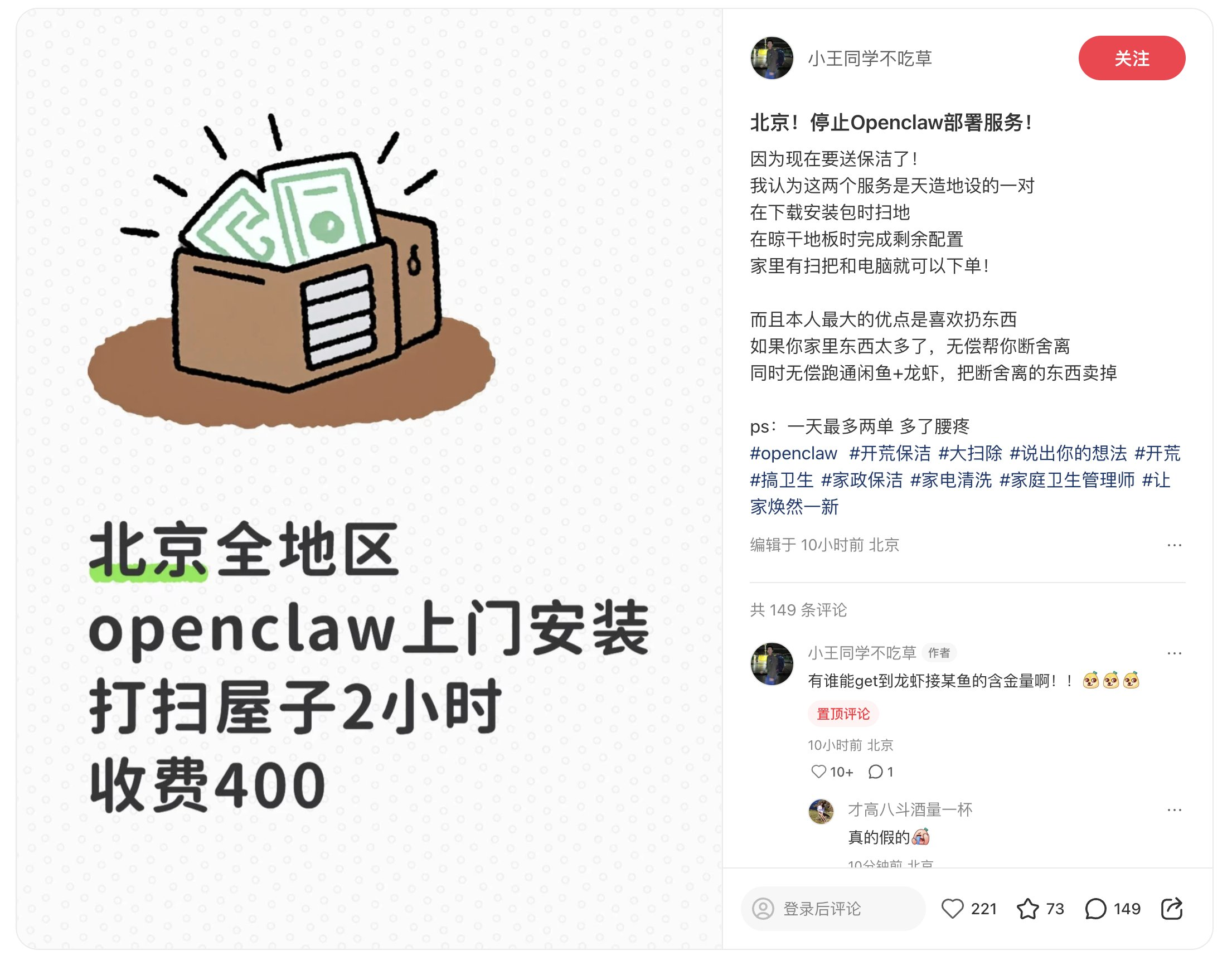
There's a three-year-old student in Nanjing who specializes in accounting, put up a post on a little red book, priced 150-200. A few days came down close to 40 singles. And he said to me, "I'm a student. I'm trying to popularize AI. It's kind of universal."
There's a Beijing programmer who says he's making extra money on weekends: "Leave at home and lay at home, come out and make a little extra money." Although not much in relation to wages, hundreds of dollars are money."
More interestingly, someone's starting to roll. They can also be cleaned.
This scene, it's like the year 2000 when the King next door was put on Windows 98. That's five bucks a time. Later, broadband was installed, then routers. Every technology wave starts with "How does this thing fit?"
However, with the exception of the installation, even the offload has now begun to roll.

Three, after the loop, Claw, the Big Bang
The heating level at the door has not gone away, and the manufacturers are no longer able to sit.
On March 9th, the byte beats, tumbles, and the dark side of the moon, the three front-runners successively publish a new product and functional update for OpenClaw.
On March 10, AutoClaw, known as the first local version of OpenClaw installed in the country, was officially online, pre-set to over 50 popular skills to support access to flying books.
On the same day, QClaw was announced as being internally tested, supporting the installation of Windows/Mac, which can be remotely operated via micro-intelligence dialogue.
A little earlier, at the end of February, MiniMax went online with MaxClaw, a cloud-based AI assistant based on OpenClaw, and was directly integrated on MiniMax Agent.
Kimi Claw, on the dark side of the moon, has an official microblogging and business Twitter plugin.
The millitech team launched the self-research side AI smart body Xiaoomi miclaw, initiating the closed test.
ArkClaw opens a byte box with a SaaS version of the cloud that will open the web page.
That's not what the community does.
ZeroClaw, rewrited in Rust, binary from 150MB+ to 3. 4MB, memory occupancy from 1GB+ to less than 5MB. It means you can run over 50 robots on an ordinary VPS.
There's a PicoClaw dedicated to IOT equipment, which aims to run on $10 hardware.
There's an "AI exclusive social network" called Moltbook, only AI Agent can register and post, and 2. 6 million AI robots interact on it.
Speaking of Moltbook, meta just bought him, and meta's going to buy it when he gets rich.

I've counted, and now the Claw on the market can name at least one of these:

Four, foster or foster
This wave of Claw booms is actually divided into two groups.
One group, including OpenClaw, ZeroClaw, PicoClaw. Suits people who are sensitive to data privacy, or prefers to mess around.
One is a cloud host, including MaxClaw, Kimi Claw, ArkClaw. It's for people who don't want to maintain the server, or set it up.
The advantage of self-cussion is that it is self-possessed and the disadvantage is that the threshold is high. OpenClaw runs for 1GB+ memory, sometimes for minutes to start. ZeroClaw is light. The memory is not occupied by 5MB, but it has to be rotated with Rust.
The advantages of cloud-based hosting are zero configuration, which allows registration. MaxClaw Professionals $199 a month, Kimi Claw Professionals Allegretto over $200 a month.
There's a difference between the two, but one thing that's common: they're consuming Token crazy.
According to the openrouter platform data, OpenClaw token on 16-22 February 2. 05T; 23 February-1 March, 2. 26T. A heavy user daily average Token consumes between 30 million and 100 million.
Huang In-hoon recently evaluated OpenClaw as "the most important software release of our time". In his view, the consumption of Token required for complex missions by intelligent bodies had increased by about 1, 000 times, creating a "calculative vacuum".
It's a water pump. On each occasion, a 24-hour token consumer was installed in user equipment and clouds.
Five, end
The Ministry of Industry and Communications issued an early warning on 8 March: the OpenClaw Open Source AI smart body section contains a high security risk with default or inappropriate configuration, and is highly vulnerable to security problems such as cyberattacks and information leaks.
This thing has too much clearance. To send an e-mail, you have to have mail privileges, and to write a document you have to have file privileges. Once used in bad faith, the consequences are unimaginable.
Peter Steinberger himself warned, "If you don't know how to use command lines, this software is too dangerous for you."
So many people now choose to deploy it on specialized equipment. In the past, Mac Mini prices went up, and the electrician web site went up to 4000+, and even the second hand on salted fish appreciated. Then the cloud manufacturer launched the application template, 2 nuclear 4G 5M server package was only 99 years old, and you found a more cost-effective solution.
Finally, if you ask me which Claw to choose, my advice is:
Don't want to mess with the server, Kimi Claw or Max Claw.
Technology lovers want complete functionality. OpenClaw.
The server is not equipped to run multiple robots.
Give the Iot device intelligence. PicoClaw.
Enterprise user OpenClaw/ZeroClaw + MaxClaw/Kimi Claw
Well, actually, you can all think of it as fun, but I just want to sort out the latest timeline.
But I'd rather say another thing.
From OpenClaw to ArkClaw, from QClaw to AutoClaw, from own hosting to cloud hosting, from door-to-door installation - The whole party was essentially a game of "who takes risks for you."
If you want to take care of yourself, you have to suffer the possibility of being hacked; if you want to give it to someone else, you have to accept that data is being looked at.
Claw went back again.
Privatization - Publicization - Privatization - Publicization. The technology turned around and finally went back to the old proposition: How much freedom are you willing to pay for security and how much risk are you willing to take for freedom?
OpenClaw's not what it means to make AI work, it's not what it moves a calculator into your house. It's about putting it back in front of everyone.
The answer?
There are no standard answers.
It is like having money hidden under the bed, having banks, buying gold, having so much money - every reason and every price.
The only sure thing is,** the law is the law**. Whatever you choose, it'll be in that corner 24 hours running, consuming Token, working for you, taking risks for you.
However, 5G has brought an era of traffic parity, and I believe that a massive domestic grid will also bring token an era of equity, because now token,** is too expensive!**